

Engineering keeps discovering elements that were always permitted but never named: the inerter, the memristor, the positron. Each completed a framework that had looked complete. Each turned out to be useful.
Monetary theory has the same shape. We speak of two kinds of money: Commodity money, which you buy by giving something up, and Credit money, which someone lends you. A third kind – Claim money, issued against attested, insured wealth that its owner keeps – is absent from civilian life. It is not absent from the economy. It is what commercial banks issue every time they "lend": new deposits, against your house, billed at the price of capital they never had.
Sorting the three kinds correctly does three things. It shows that interest on bank issuance has no cost behind it. It shows that most of what we call debt is a lien on the borrower's own wealth, wearing a lender's vocabulary. And it shows what changes when the owner of the wealth does the issuing: the same money, the same insurance, and no one to pay.
DeFi has already shown that civilians will do this at scale. Alberta has the wealth, the constitutional room, and the Alberta Buck blueprint to do it properly. (PDF, Text)
The Pattern of Missing Elements
The Inerter
For a century, mechanical engineers had three elements: the spring (force proportional to displacement), the damper (force proportional to velocity), and mass (force proportional to acceleration). With levers and linkages, the three seemed to describe every mechanical behaviour.
In 2002 Malcolm Smith, at Cambridge, noticed that the standard analogy between mechanical and electrical systems was one element short. Circuits had four fundamental elements; mechanisms had three. He built the missing one: the inerter, a two-terminal device whose force is proportional to the relative acceleration of its ends.1 Formula 1 teams adopted it within a few seasons and got suspension behaviour that had been thought impossible. The element had always been allowed by physics. Nobody had asked for it.
The Memristor
Leon Chua predicted the memristor in 1971 from symmetry alone.2 Three two-terminal elements related the four circuit variables – voltage, current, charge and flux:
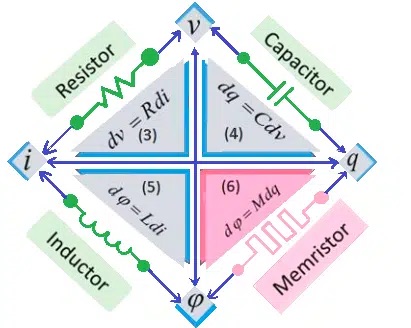
The relationship between charge and flux had no element. Chua named it, and described what it would do: its resistance would depend on the history of current through it. Thirty-seven years later HP Labs built one, and it did exactly that.3 Memristors now underlie neuromorphic hardware that conventional components cannot match.
The Positron
Dirac's 1928 equation for the electron had an embarrassing feature: solutions with negative energy. Rather than discard them, he proposed they described real particles with positive charge. Carl Anderson found the positron in cosmic rays four years later. The antimatter had been streaming through the atmosphere the whole time.
The Pattern
- A framework appears complete.
- A symmetry argument reveals a gap.
- The missing element, once named, proves transformative.
- In retrospect, the gap is obvious.
Monetary economics has such a gap. It has been hiding behind a word.
Two Moneys, or Three?
Ask anyone how money comes into being and you will hear two answers.
Commodity Money: You Give Something Up
Gold, silver, cattle, Bitcoin. You obtain it by selling something: your labour, your goods, your time. It is substitutionary: you hold the money instead of what you exchanged for it – wealth or liquidity, never both at once. Its supply is set by scarcity. Its value comes from the thing itself, or from what you gave up to get it. This is the money of classical economics and of the hard-money revival.
Credit Money: Someone Else Gives Something Up
A loan. Someone who has money gives you the use of it for a while. They do without it, and they may not get it back, so they charge interest: a price for time, and a price for risk. Pension funds do this. Bond investors do this. Your uncle does this. Nothing in this paper objects to it.
Credit money has a test. After the loan is paid out, the lender's balance sheet is the same size as before: cash went out, a receivable came in. The lender had something, and now has less of it. That is what makes the interest honest.
The Money Everyone Means by "Credit"
When economists say "credit money" they usually mean bank deposits – nearly all of the money supply, brought into being whenever a bank writes a mortgage or a business loan. Textbooks file this under Credit. It fails the test.
Richard Werner ran the experiment in 2014: he borrowed from a bank and watched its books.4 At signing, the bank recorded his promise to pay as an asset, and an equal amount owed to him as a liability – the same as any lender. Then came "disbursement". Where a pension fund would send cash and shrink, the bank renamed the liability "customer deposit" and stopped. Nothing left. The balance sheet stayed enlarged. The Bank of England said the same thing the same year, in plainer words: banks create new money when they lend.5
So the deposit was not lent. It was issued. Nobody at the bank did without anything, so the thing that makes interest honest is not present. The word "credit" is doing work the ledger does not support.
The Missing Element: Claim Money
Definition
Claim money is money issued against a claim on owned, attested and insured wealth that the owner keeps and keeps using. Nothing is sold, so it is not Commodity money. Nothing is lent, so it is not Credit money. The owner holds both the wealth and the money, until one of two things happens:
- The owner retires the money they issued, releasing the claim; or
- The asset is actually lost – fire, theft, destruction – and the insurer settles the owner's obligation and takes the salvage its premiums paid for.
Note who holds the claim on the asset: the owner's insurer, and no one else. The money itself is fungible, backed by the aggregate of all pledged wealth and redeemable against none of it in particular. No holder can present Claim money and demand the underlying house. The one party who ever "redeems" is the issuer, retiring what they issued.
Three Questions
Every money answers three questions. Did it exist before this transaction? Whose wealth stands behind it? Who parted with something to bring it into being?
| Question | Commodity Money | Credit Money | Claim Money |
|---|---|---|---|
| Existed before? | Yes: the thing itself | Yes: the lender's money | No: issued now |
| Acquired by: | Exchange (a sale) | Borrowing | Attestation (a pledge) |
| Stands behind it: | The commodity | Lender's capital, borrower's promise | Attested, insured wealth under lien |
| Who parts with: | The seller, the goods | The lender, the money | No one parts with money; the owner |
| encumbers the asset | |||
| Owner ends with: | Money, not the wealth | Liquidity and a debt | Wealth and liquidity |
| Interest pays for: | – | Forgone use, plus risk | Service only; the rest is seigniorage |
| Retired by: | Never | Repayment to the lender | Release of the issuer's own lien |
| Limited by: | Physical scarcity | Available savings | Attestable wealth |
| Examples: | Gold, wheat, Bitcoin | Bonds; a pension fund's mortgage; | Gold-standard notes; elevator |
| a credit card; your uncle | receipts; BUCKs; bank deposits |
Read the last row twice. Bank deposits are in the third column. They are priced from the second.
The Ledger Test
You need not take anyone's word for which column an instrument belongs in. Look at the lender's balance sheet the moment after the money goes out. If it shrank on the asset side – cash out, receivable in – the money existed before, and this is Credit. If it grew on both sides, the money was issued, and this is Claim money, whoever's name is on the lien. Werner's Table 3 is the bank's answer.4 It grew.
The test also tells you what the interest is for. A lender's balance sheet shrank, so the interest pays for what left. An issuer's did not, so the interest must be paying for something else. It is: a second contract, examined below.
The Price Test
Interest has three parts: payment for time (the lender does without their money), payment for risk (they may not get it back), and payment for service (someone has to run the loan).
For a real lender all three are real. For a bank issuing against a pledge the first is zero: no money it held went anywhere. Someone did give something up – the owner, whose house is now encumbered and cannot be sold or pledged again until the claim is retired.6 That cost is real, and the owner bears it. The note then bills the owner a second time, as if the bank had also supplied scarce funds. The second part, risk, is small and mostly somebody else's: the owner buys the insurance, puts up the equity, and pledges the asset under a lien; the bank keeps only a residual. The third is a fee, and a modest one.
Banks do bear costs: the equity regulators make them hold, interest on deposits, buildings and staff. These are an administrator's costs, and an administrator's fee would cover them. What the mortgage rate charges for is different. It charges for the forgone use of scarce capital. The bank charges the price of scarce capital for a thing that is not scarce capital. Everything between that price and an administrator's fee is seigniorage – the Architecture works out how much – and it is why an industry producing about 7% of Canada's output books about 30% of its after-tax corporate profits.7
The Price Sits Between Two Fences
Turning an insured house into spendable money is a real service, and it should have a price. What is fair? Put up two fences.
The low fence is what it costs to do the job plainly: attest the asset, insure it, keep the ledger. That is the Alberta Buck's bid, roughly half a percent to one and a half percent a year. The high fence is what a real lender must charge – a pension fund, or a private fund lending its investors' committed capital – because they part with the principal and must be paid for the time and the risk.
The bank sells the service at the high fence and produces it at the low one. Here is the tell: a bank and a pension fund quote the same rate on the same house, with balance sheets that could not be more different. One parted with the money. The other wrote it. If interest were the price of the service, the two prices could not match. The gap between the fences is the seigniorage, and the financial sector's share of the nation's profits is its footprint.8
The Elevator Does Not Charge Interest on Your Grain
Alberta has issued Claim money for a century. Deliver wheat to an elevator and you receive a receipt: a fungible claim, good against the pool of grain, that can change hands until someone presents it. The elevator charges you for handling, and storage by the month – a carrying fee on the receipt, which is exactly what the BUCK's demurrage is. It does not charge you five percent a year on the value of your own wheat, and it does not call the receipt a loan. An elevator that tried would lose its customers by the next harvest.
That is the whole distinction. The elevator administers the liquidity of your wealth. So does a bank. One bills like an administrator. The other bills like a lender.
Why "Claim Money"?
The name says what happens: money is created from a claim on wealth its owner keeps. It also completes a triad that scans – Commodity, Credit, Claim.
Other names stress other aspects. Asset money or wealth money name the backing; equity money the owner's stake; secured money or pledge money the lien. The lawyer's word is hypothecation: pledging an asset as security while keeping possession of it. A mortgage is a hypothecation. So is a BUCK. The difference between them is who issues the money the pledge backs, and what they charge for it.
Frederick Soddy objected that bank money is "a legal claim to wealth … already in the ownership of others."9 He was right about bank money. Claim money issued by the owner is a claim on the owner's wealth alone, bounded by it, insured on it, and retired by the same hand that issued it. That is the option Soddy did not consider (Fertile Obfuscation).
Two later schools came closest. Heinsohn and Steiger's property theory holds that money is born when property is encumbered, and that interest is the price of the encumbrance.6 Frank Decker separates claims issued by debtors from claims issued by banks – notes and deposits – and builds a synthesis around claims to property.10 Both describe what money is, and both are worth reading. Both also leave the bank deposit filed under credit and its interest filed under compensation. Neither asks the question this essay asks: if the encumbrance is the owner's, why is the bill the bank's – and what happens when the owner issues the claim directly?
Not a New Idea
The gap has been sensed before, always a technology short of closing.
John Law (1705) proposed money issued against land by a national land bank, with the land left in its owners' hands.11 His French implementation drowned in speculation and over-issue, having neither attestation nor insurance; the principle survived the wreck.
Adam Smith (1776) endorsed notes issued against "real bills" – short-term claims on attested goods in production or transit.12 Thornton refined the doctrine in 1802. It stayed confined to trade finance and short horizons.
Colonial land banks (1714-1751) issued paper against mortgaged farms; Franklin called it "coined land."13 Pennsylvania's held its value; Rhode Island's did not. Parliament ended the experiment in 1764. The notes were debt, at interest, and had no insurance behind them.
The Swiss WIR (1934-present) lets sixty thousand businesses issue against pledged assets, and has run for ninety years without troubling the franc.14 It is business-to-business only, at interest, and without insurance.
Each of these lacked one or more of four things: fungibility across unlike assets, cheap attestation, discount-free circulation, and a stable unit. Those are now engineering problems, and they have engineering answers.
The Element Isn't Missing. It's Mislabelled.
Put the two findings together. Commercial banks issue Claim money, against their customers' wealth, every working day. They call it lending. The vocabulary of the second column – loan, principal, interest, default – is applied to an operation from the third.
Two Contracts, One Signature
The clearest way to see it is to notice that a mortgage is two contracts, signed with one pen and named after the second.
The pledge. You grant a lien on an insured house. The bank issues a deposit. Its books balance:
| Bank books: the pledge | Debit | Credit |
|---|---|---|
| Claim on you, secured by lien (return $380k) | +$380k | |
| Your deposit | +$380k | |
| Bank's net position | $0 |
This is the money event, and it is complete. It has two natural endings: you return $380k and the lien is released (reverse the two entries), or the house is lost and the insurer settles. It needs a cushion against the asset losing value – a down payment, or default insurance – but it does not need a schedule, it does not need interest, and it does not need you to lose the house for missing a payment, because there is no payment to miss. The bank's profit from this contract is zero.
The note. You also sign a promissory note: amortize the $380k over twenty-five years, pay 5% a year on the balance, and if you miss the schedule the lienholder may accelerate and sell the house. This contract creates, for the bank, about $286,000 of interest income and a marketable security; and for you, a fixed monthly obligation and the possibility of foreclosure. Every dollar the bank earns on the mortgage comes from this contract. Nothing in the first contract required it.
The pledge is Claim money. The note is what makes it look like Credit. Bundle them and call the bundle a "loan", and the interest looks like the price of the money rather than what it is: a second agreement, layered on a complete one, for which the bank supplied no capital.
The Alberta Buck is the first contract without the second. Same lien, same insurance, same deposit; no schedule, no interest, no forfeiture for non-payment. The Jubilee and the option to redeem supply the endings the pledge already had.
What the Note Does on the Books
Three things follow, and none of them requires a villain. Everyone inside believes they are lending, and the words were in place before anyone now working was born.
- The "loan asset" is the pledge's administrative record. It records that you owe the system back the liquidity issued through the bank, and that a lien secures it. A registrar of liens has such a record. A registrar does not have a lender's claim to interest on it.
- The note manufactures a second asset. Twenty-five years of payments, priced as if a lender had parted with capital. No lender did, so the yield compensates no one for anything. It is the seigniorage, capitalised. The Alberta Buck overview works the example: $603,016 of it on an $800,000 mortgage.
- The note is sold. Packaged with others as mortgage-backed securities or covered bonds, the manufactured asset is exchanged for existing money, and the seigniorage is realised up front. Nothing about this is illegal. It is simply not lending.
Jackson and Kotlikoff proved that banking crises are misrepresentation events, not liquidity events.15 They looked for misrepresented risk on particular balance sheets. The larger misrepresentation is in the noun. A truthful ledger would show four lines: your asset (the deposit), your liability (the lien), the insurer's exposure (paid for by premiums), and the bank's fee. Everything the actual ledger shows beyond that is the note – the cost of the wrong word.
The missing monetary element is not missing from the economy. It is missing from civilians, and it is filed under the wrong name.
What Should You See If This Is Right?
A label that changes nothing is decoration. This one predicts four things you can check.
- Banks and funded lenders quote the same rate on the same collateral, though one parted with the principal and the other wrote it.
- The sector that issues the money books a share of profits far out of proportion to its share of output.
- Securitisation is built on the note, not the pledge: what gets packaged and sold is the payment stream.
- Wherever owners are allowed to issue against their own pledges – as DeFi now permits – demand appears, and the price of liquidity against the same collateral falls toward the fees.
All four are visible today.
Why Claim Money Stayed Small
People have handled Claim money for centuries without calling it that. A cheque is a claim on a bank balance that circulates until it clears. An elevator receipt is a claim on stored grain. A warehouse receipt is a claim on stored metal or goods. In each case the asset stays put and the claim changes hands. None of them became broad money, for four reasons.
Four Limitations
Slow ledgers. Paper had to be carried, checked and settled. A cheque is not money until it clears. That confined certificates to large transactions between parties who trusted each other.
Non-fungibility. A receipt for 100 bushels of Canada Western Red Spring in elevator #7 was not interchangeable with one for Soft White in elevator #12. Each claim needed its own verification and valuation. That is barter with extra paperwork.
Discount trading. Certificates traded below face to cover settlement risk, verification cost and the expense of liquidating the underlying. Anything that trades at a discount is not money; it is a negotiable claim that must be converted, at a loss, before it can be spent.
Illiquid backing. The decisive one. Certificates worked only where the underlying could be sold tomorrow at a posted price: grain, gold, silver. Real estate, land, equipment, businesses – the bulk of civilian wealth – have no such market. A certificate reading "claim on 123 Main Street, assessed at $500,000" would have traded at a ruinous discount, if at all. Who would take it without verifying title, condition, encumbrances and marketability? The transaction costs exceeded the payment.
The grain in the elevator can be sold tomorrow. The house cannot. That is why Claim money stayed in the elevator.
The Breakthrough: Fungible Money from Illiquid Assets
The Alberta Buck differs from every historical form of Claim money in one respect:
It turns illiquid assets into discount-free, fungible broad money.
Four elements do it, none of which was available or affordable before:
- Insurance. Guarantees the backing regardless of market or condition. If the house burns, the insurer settles the owner's obligation, so the aggregate backing behind every BUCK stays whole, asset by asset, without any holder needing recourse to any asset.
- Attestation. Cryptographic verification of ownership, value and insurance status. Oracles and smart contracts do instantly what once took clerks, notaries and auditors.
- Fungibility. A BUCK minted against a house in Calgary is indistinguishable from one minted against farmland near Lethbridge, because no BUCK is a claim on its asset. Each records only where it entered the system. In circulation every BUCK is backed alike by all pledged wealth. The house doesn't back your BUCK; it backs the BUCK.
- Feedback control. PID controllers adjust the credit multiplier
BUCK_Kto hold the BUCK at parity with a commodity basket, so it circulates at face and neither inflates nor deflates.
With these, an owner can in effect write a cheque against their real estate that circulates at face, never forces a sale, spends like cash, and works for any asset that can be insured and valued. A homeowner with $300,000 of equity can mint $200,000 in BUCKs, spend them, keep living in the house, and lose the house only if it is actually destroyed – never for a price move, a thin market, or a missed payment.
The cheque stays out until the homeowner retires it by selling the house, or until the demurrage-funded Jubilee retires the lien for them. No one can present it against the house. The homeowner who minted BUCK$200,000 is the one party who must gather and return BUCK$200,000 to clear the lien. Supply expands as wealth is pledged and contracts as liens clear, leaving no unbacked overhang and no debt that must be rolled forever because retiring it would destroy the money.
| Aspect | Traditional Mortgage | Alberta Buck |
|---|---|---|
| Underlying mechanism: | Bank issues Claim money from your house | You issue Claim money from your house |
| Who issues: | Bank (from your asset) | You (from your asset) |
| Obligation created: | Debt, at interest | Redemption of your own lien, no interest |
| Cost to access value: | $10,000-30,000/year (interest) | $1,000-3,000/year (insurance premium) |
| Risk of asset loss: | Foreclosure (payment default) | Insurance claim (actual loss) |
| Who profits: | Bank | You |
| Asset liquidity: | Irrelevant (bank forces sale) | Irrelevant (insurance guarantees) |
Insurance removes liquidation risk. Attestation removes verification cost and settlement delay. Fungibility removes barter friction. Feedback control removes the discount. What remains is putting the capability – which banks already exercise on your wealth – in your hands.
The Gold Standard: Claim Money With One Issuer
The most successful Claim money in history was not the warehouse receipt. It was the gold-backed dollar. From 1879 to 1933 at home, and to 1971 abroad, a dollar was a claim on gold the government held. The government kept the gold; the note circulated. It was fungible, discount-free, instantly settled, and stable. It carried the largest expansion of output in human history. The Alberta Buck16 may carry the next.
The Issuance Monopoly
The gold standard had one issuer. A citizen with $10,000 in gold had three choices: sell it to the Treasury for dollars, hold it and get nothing, or deposit it at a bank and borrow at interest. He could not issue $10,000 of circulating money against it. Only the government could.
The consequences followed in a straight line. Growth needed money. Money needed government gold. Government got gold by taxing, borrowing or running a trade surplus. When private wealth grew faster than the reserve, prices fell, debts became unpayable, and there was a depression – 1873 to 1896, and 1929 to 1933. The standard did not fail because backing money with wealth is unworkable. It failed because one issuer was a bottleneck on everyone else's wealth.
Gold-Backed Dollar vs. Alberta Buck
Both back money with attested, secured wealth. The difference is who may issue:
| Feature | Gold-Backed USD (1879-1971) | Alberta Buck |
|---|---|---|
| ISSUANCE | ||
| Who can issue money: | Government/Fed only | Any citizen with attestable wealth |
| Reserves required: | Government gold holdings | Private assets (house, land, equipment) |
| Issuance limited by: | Government gold acquisition | Total private wealth in jurisdiction |
| Access mechanism: | Taxation → gold purchase → issue | Insurance → attestation → issue |
| Cost to access: | N/A (citizens can't issue) | Insurance premium (~0.5-1.5%/year) |
| CONVERTIBILITY | ||
| Who can redeem: | Foreign central banks (post-1933) | Only the issuer (retiring their mint) |
| Redemption delivers: | Physical gold | Release of the issuer's own lien |
| Holder's claim: | Gold on demand, from the reserve | None on any asset; backed by aggregate |
| Redemption required: | On demand (until 1971) | When issuer sells asset (or via Jubilee) |
| Backing kept whole by: | Government promise | Insurance (on loss) + issuer's lien |
| OPERATIONAL | ||
| Fungibility: | Perfect (all USD identical) | Perfect (all BUCKs identical) |
| Discount trading: | No (government backing) | No (insurance backing) |
| Asset liquidity requirement: | Liquid (gold markets) | Any (insurance eliminates need) |
| Settlement speed: | Instant (paper) / Slow (gold) | Instant (blockchain) |
| Geographic scope: | Global (reserve currency) | Jurisdictional (initially Alberta) |
| WEALTH EFFECTS | ||
| Private wealth monetization: | No (only gov't can issue) | Yes (any owner can issue) |
| Money supply coupled to: | Government gold reserves | Total private wealth |
| Supply bottleneck: | Gov't acquisition rate | None (scales with wealth creation) |
| Deflationary pressure: | Severe (supply can't keep up) | None (supply auto-adjusts) |
| Wealth concentration: | Increases (only gov't monetizes) | Decreases (everyone can monetize) |
| Labour value capture: | No (can't monetize improvements) | Yes (issue against improvements) |
The gold standard proved Claim money works at scale. Its single issuer was the bottleneck. The BUCK keeps the backing and removes the bottleneck.
What Follows
When the owner of the wealth does the issuing, the change on the ledger is small. Everywhere else it is large. Take the effects in order.
First Order: Same Money, Same Wealth, No Rent
The money supply does not change. The same $380,000 is issued against the same $505,000 house, under the same insurance and the same kind of lien. What changes is the payee: about $19,000 a year in first-year interest becomes about $1,900 a year in premiums. Anyone who fears that civilian issuance is inflationary should notice that the bank is already doing it. The BUCK moves the issuer, not the quantity.
The note is never signed. The pledge stands alone. There is no payment stream, so there is no bond to sell and no yield to capitalise. The $603,016 on an $800,000 mortgage does not go to someone else. It does not come into existence.
Default is impossible. There is no schedule, so there are no payments to miss. Loss of the asset is an insurance event, settled by the insurer, who takes the salvage it was paid for. Price moves, thin markets and bad years cannot take the house. The forfeiture clause went out with the note.
Redemption is on the owner's terms. Retire the BUCKs when you sell, or let the demurrage-funded Jubilee retire the lien over time (The Best Bad Money).
Second Order: Debt Becomes Encumbrance
Most "debt" is collateral debt. Alberta's roughly $500 billion breaks down as residential mortgages $197B, farm debt $37B, small business $40B, corporate $145B and provincial $83B.17 The mortgage, farm, small-business and provincial lines are secured against wealth or taxing power, and much of the corporate line is too. Under Claim money each becomes a lien on the owner's own wealth: no creditor, no schedule, no interest. The word "debt" stops applying. Unsecured credit – cards, unsecured lines, the loan from your uncle – remains, and remains honestly priced, because there a lender really did give something up.
Real lenders get an honest market. Rates on genuine credit come to reflect the scarcity of real savings, not competition with issuance dressed as lending. Savers may still lend BUCKs at interest to anyone they like.
Banks become what they are. Registrars, custodians, attestors, payment processors. Fee income replaces "net interest income". A sector producing 7% of output stops booking 30% of the profits, and the difference stays with the people whose wealth backed the money.
The money supply tracks wealth, not compounding interest. Every deposit was issued as principal. The interest owed on it was not issued at all. So at any moment the debts outstanding exceed the money in existence by all the interest still to come, and if every debt were unwound at once the money would run out before the debts did. Someone must forgive the interest, or someone must borrow it into being.18 Global debt now exceeds $330 trillion, over 300% of world output.19 Claim money carries no interest, so every lien can be retired with exactly the money issued against it. Paying them down does not destroy the medium of exchange, and the debt-deflation spiral has nothing to run on.
Securitisation shrinks to genuine credit. The mortgage-backed-security machine exists to sell the manufactured second asset. With no second asset there is nothing to package.
Labour can compound like capital. A renovation that adds $50,000 to a house can back $30,000 of liquidity the same month, without a sale and without a loan. Improvements to wealth become spendable by the people who made them.
Third Order: What a Generation Does With It
Housing. Replace interest with premiums and the income multiple of a home falls back toward what it was in 1970, when a house cost three to five years of income rather than ten to fifteen. A single-income family becomes arithmetically possible again. Alberta's fertility rate is 1.41, a third below replacement.20 A house that costs fifteen years of income is not the only reason, but it is one a monetary system can change.
Enterprise. A business with equipment, inventory and receivables can fund growth from its own balance sheet, without dilution and without a credit committee.
Fiscal autonomy. A province that can issue against its own infrastructure does not need a bond desk's permission to build a hospital (Objections). Nothing about this touches monetary policy or the Canadian dollar. It touches who pays interest, and to whom.
Resilience. Issuance distributed over thousands of insured assets has no single promise to break. The gold standard broke when its one issuer broke its promise, in 1933 and again in 1971.
Why Hasn't This Happened?
A Word, and a Privilege
Economists spent centuries arguing commodity against credit and did not see the third column, because the third column was labelled with the second column's name.
Werner's other finding explains the privilege.4 Banks alone are exempt from the Client Money Rules that would make anyone else's self-issued "deposit" worthless. That exemption is the licence to issue. Nobody has to be a villain for the arrangement to persist; the vocabulary does the work, and the people who benefit from it are as convinced by it as everyone else.
Technical Barriers, Now Solved
Until recently Claim money faced four practical obstacles:
- Attestation: verifying what someone owns and what it is worth
- Insurance: pricing and carrying the risk that backing assets are lost
- Fungibility: making claims on unlike assets interchangeable
- Settlement: retiring claims when the owner sells the wealth
Blockchains, smart contracts, parametric insurance and decentralized oracles have solved each. The barriers fell within the last decade.
Validation: DeFi
MakerDAO, the largest decentralized stablecoin, accepts tokenized real-world assets as collateral to mint DAI.21 Owners tokenize real estate, bonds or receivables, pledge them, and mint dollar-equivalent DAI while retaining beneficial ownership. Over $5 billion of DAI now rests on such backing.22 This is Claim money, issued by civilians, at scale. Demand is not in question.
The implementation is crude. Without insurance or legal recourse, the protocols liquidate on price moves rather than on actual loss – foreclosure by algorithm (Insurance vs. Liquidation). DAI has no standing to settle taxes or debts at law, and no finality outside its contracts. DeFi proves the concept. It does not perfect it.
Meanwhile Wyoming authorized a state stable token in 2024,23 showing that sub-federal jurisdictions will act in digital money. Its statute requires full reserves but does not exclude insured real-asset backing as the rules mature. Hayek argued that the quality of money is discovered by competition among issuers, not designed by a monopoly.24 That discovery is under way. The open question is which jurisdiction implements the well-built version first.
What Is Not Settled
An argument that names its open questions is easier to trust than one that has none. Four remain, and each has a home in the companion papers.
- Honest attestation. Owners have every reason to overstate what they pledge. The answer is many small insurers, each with capital at risk on its own valuations, rather than one auditor (decimation). It is a design, not yet a track record.
- Moneyness. A BUCK must clear at par for wages, rent and taxes, or part of what banks charge is payment for legal moneyness rather than for the pledge. The legal route is in the Objections; the market route is adoption.
- Stability under noise. Attestations are imperfect and insurance is never complete. The controller that holds the BUCK at par must digest that (the Stability Triangle).
- The size of the gap. How much of a mortgage rate is the honest price of the residual services a bank still provides, and how much is the label? That is a measurement, not an argument, and it has not yet been made.8
Alberta's Moment
The Convergence
No other jurisdiction combines all five:
- Attestable wealth: $1.6 trillion in real estate, $50+ billion in agricultural assets, proven reserves measured in centuries, and a population that owns a great deal of it outright.
- Constitutional room: under s. 92(13) of the Constitution Act, 1867, Alberta has exclusive jurisdiction over property and civil rights, which is to say contracts, liens and insurance – the legal machinery Claim money is made of.25
- Precedent: ATB Financial has operated outside federal banking jurisdiction since 1938.26
- Necessity: Albertans send about $23 billion a year out of the province as interest on liquidity issued from their own assets.
- Capability: the ledger, contract and oracle infrastructure exists and runs in production.
The Blueprint
None of this is hypothetical for Alberta. The Alberta Buck sets out the case. The
Architecture specifies the tokens, the NFT credit limits, the parametric insurance, the
BUCK_K controller and the commodity basket.27 The Legal Foundation establishes the
provincial jurisdiction, the non-conflict with federal currency powers, and the PPSA lien
mechanics.28 The Transition Roadmap shows what a family, a farmer and a treasurer
experience at each phase.
What It Is Worth
Replacing interest with premiums cuts the cost of accessing home equity by 80% to 90%. A family keeps $9,000 to $27,000 a year. The province retires $3.2 billion a year of debt service by issuing against infrastructure it already owns and keeps public. In aggregate, $23 billion a year stays in Alberta and circulates here.
Those are first-order estimates; the assumptions behind them, and how they move with interest rates, are worked in the Architecture and the Transition Roadmap. The second and third orders – homes at three years' income, businesses funded from their own balance sheets, a sector paid for what it does – are the ones a generation will notice.
The Choice
The technology has arrived. The demand is demonstrated. The constitutional room exists. The question is not whether Claim money reaches civilians; DeFi settled that. The question is whether the first well-built version – insured, attested, jurisdictionally stable, denominated in real things – is built here, by the people whose wealth already backs the money, or somewhere else, on someone else's terms.
Conclusion: The Element That Completes Everything?
For centuries civilians have had two ways to turn wealth into money: sell it, or borrow against it. The third way existed. Banks used it every day, on our wealth, and billed us as if it were the second.
That mislabel shaped the modern economy in ways we came to think natural: labour undervalued against capital, debt growing faster than output, houses priced like vaults, a generation unable to form families. These are not policy failures. They are what a framework does when one of its elements is filed under the wrong name.
Is the list complete? I believe so. Money reaches your hand by one of three roads: you sold something for it, someone lent it to you, or it was issued against something pledged.29 I have not found a fourth road, and would be glad to hear of one.
Claim money is, in one sentence, liquidity issued against insured wealth its owner keeps, retired by the same hand that issued it, and owed to no one in between.
It gives a family the use of what it already owns, without selling the house and without a schedule to miss. It gives real lenders an honest market, priced for real savings. It gives banks an honest job – attestation, custody, payments – paid for what it costs. It gives a province the means to build without asking a bond desk. It leaves the dollar to Ottawa and lending to lenders. And it does all of this with no new law, no more money than banks already issue, and no one to pay – only a lien, an insurer and a ledger, three things Alberta already has.
Claim money cannot make anyone richer than their wealth. It was never meant to. It can do something rarer: let you spend what you own, and keep it. Banks have done that for us for a century, and kept the credit. Alberta can be the first to hand it back.
Footnotes
Smith, Malcolm C. (2002). "Synthesis of Mechanical Networks: The Inerter." IEEE Transactions on Automatic Control.
Chua, Leon O. (1971). "Memristor—The Missing Circuit Element." IEEE Transactions on Circuit Theory.
Strukov, D.B., et al. (2008). "The missing memristor found." Nature 453, 80-83.
Werner, Richard A. (2014). "How do banks create money, and why can other firms not do the same?" International Review of Financial Analysis, vol. 36, pp. 71-77. Werner's Tables 1-3 compare the balance sheets of a non-financial firm, a non-bank financial institution and a bank before and after a loan is disbursed; only the bank's remains enlarged. The paper also documents the exemption of banks from Client Money Rules that makes this possible.
McLeay, Michael, Amar Radia, and Ryland Thomas. (2014). "Money in the Modern Economy" Bank of England Quarterly Bulletin.
Heinsohn, Gunnar and Otto Steiger. Eigentum, Zins und Geld (1996); in English as Ownership Economics: On the Foundations of Interest, Money, Markets, Business Cycles and Economic Development, ed. Frank Decker (Routledge, 2013). They call the yield on unencumbered property – the freedom to sell it, pledge it or use it as one likes – the property premium, and treat interest as compensation for giving it up. In their account the encumbrance that matters is the creditor's: a bank pledges its own capital so that its notes will be accepted. This essay agrees that the encumbrance is the cost, and points out who actually bears it: the owner, whose house is liened, not the bank, whose own capital at risk is a thin regulatory residual – and one largely socialized by deposit insurance and the central bank.
Sharpe, Andrew, Jean-François Arsenault, and Daniel Ershov. "What Explains the Rising Profit Share in Canada?" Centre for the Study of Living Standards, 2020. Finance and insurance drove 33% of Canada's increase in corporate profit share from 1997 to 2017, four-fifths of it from rising margins rather than rising output share; the sector contributes about 7% of GDP and captures about 30% of after-tax corporate profits. See Financial System Malfeasance.
As a bound rather than a point: P(insurance + attestation) <= P* <= r(funded lender), where P* is the competitive price of turning attested, insured wealth into a par, transferable claim. Two conditions make the bound tight: the claim must clear at par for ordinary payments (moneyness), and the insurance must survive until the lien is retired and pay on actual loss, not on a price wobble. The clean right-hand comparison is a lender whose liability is neither money nor a state-guaranteed security – a pension fund holding whole mortgages, or private credit funded by committed equity. Canadian non-bank mortgage lenders funded through insured mortgage-backed securities are not a clean control; that is another public-guarantee channel. The bank's residual is largest on uninsured mortgages, where it keeps real price-decline risk; even there the deposit was written, not lent, so the residual's price is a credit spread, not the whole rate. Measuring the gap – mortgage spread less deposit cost, expected loss, operating cost, and a fair return on the actual equity sliver, insured versus uninsured, bank versus pension book – is future research.
Soddy, Frederick. The Role of Money (1934), quoted in Anielski, Mark. "Fertile Obfuscation: Making Money Whilst Eroding Living Capital" (2000), p. 25. Soddy's remedy was to let no private person create money at all – commodity money, earned first. He did not consider the owner of the wealth as issuer.
Decker, Frank. "Property Ownership and Money: A New Synthesis." Journal of Economic Issues 49(4), 2015. Decker distinguishes debtor-issued claims (negotiable instruments, book accounts) from creator-issued claims (bank notes, bank deposits), identifies eight historical monetary arrangements, and integrates commodity, state, credit and ownership-based views of money around claims to property.
Law, John. Money and Trade Considered, with a Proposal for Supplying the Nation with Money (1705). Law's French implementation (1716-1720) collapsed under over-issue and the Mississippi Company speculation; the principle of monetizing land without transferring possession survived it.
Smith, Adam. An Inquiry into the Nature and Causes of the Wealth of Nations (1776), Book II, Chapter II; Thornton, Henry. An Enquiry into the Nature and Effects of the Paper Credit of Great Britain (1802).
Thayer, Theodore. "The Land-Bank System in the American Colonies" (1953). Journal of Economic History 13(2): 145-159. Colonial loan offices issued paper against mortgaged real estate at capped interest; Franklin defended Pennsylvania's as stable money without specie's deflations. The Currency Acts of 1751 and 1764 suppressed the systems.
Stodder, James. "Reciprocal Exchange Networks: Implications for Macroeconomic Stability" (2005). The WIR Bank (1934-present): over 60,000 Swiss businesses, ninety years of operation, counter-cyclical usage; business-to-business only, without consumer real estate or insurance.
Jackson, Timothy and Laurence J. Kotlikoff. "Banks As Potentially Crooked Secret Keepers" Boston University, 2020; Journal of Money, Credit and Banking 53(7), 2021. Banking crises modelled as misrepresentation (malfeasance) events rather than liquidity events. See What Kotlikoff Proved – and What He Missed.
One structural difference from the BUCK: a gold-standard holder could present dollars and demand metal from the reserve. A BUCK holder holds no such right against any pledged asset. Redemption under the BUCK is the issuer's act of retiring what they minted, with each asset's insurer guarding the backing. Same fungibility; the direction of redemption is reversed.
Sources and derivation in the Transition Roadmap: CMHC Mortgage and Consumer Credit Trends (2024) for residential mortgages; Statistics Canada Table 32-10-0051-01 for farm debt; Alberta Budget 2025 Fiscal Plan for taxpayer-supported provincial debt. Annual interest of about $23 billion assumes prevailing rates by sector.
The usual reply is that banks spend their interest income – wages, dividends, rent – so that year to year the flow can balance without new borrowing. True, and beside the point. The recirculation works only while the debts are rolled forward. The stock of money never equals the stock of debt plus the interest due on it; the shortfall is exactly the interest, and every default, write-off and bankruptcy is the forgiveness that closes it. A system that must forgive or refinance to stay solvent is not one that can be unwound.
Institute of International Finance. Global Debt Monitor, 2024.
Statistics Canada. (2024). "Fertility rates and number of children per woman, by province and territory, 2023" Alberta's total fertility rate of 1.41 children per woman, against a replacement rate of 2.1.
MakerDAO. "Real-World Asset (RWA) Collateral" (2024). Tokenized corporate bonds, real estate, invoices and structured credit accepted as collateral for minting DAI against overcollateralized positions.
DeFi Llama. "MakerDAO TVL and Collateral Composition" (2024). Over $5 billion in total value locked, with real-world assets a growing share of the collateral behind the $4.5+ billion DAI supply.
Wyoming Stable Token Commission. Wyoming Stable Token Act, 2024 Wyo. Sess. Laws ch. 44 (codified at Wyo. Stat. Ann. §§ 13-12-101 to 13-12-115). The Act requires 100% reserve backing but does not specify reserve composition.
F.A. Hayek. "Denationalisation of Money – The Argument Refined" (1974). Competitive private issue, with convertibility and exit rather than legal tender laws enforcing monetary discipline.
Constitution Act, 1867, 30 & 31 Vict, c 3, reprinted in RSC 1985, Appendix II, No 5. Section 92(13) grants provinces exclusive jurisdiction over "Property and Civil Rights in the Province," which encompasses contracts, property law, insurance regulation, and civil transactions – the legal mechanisms Claim money requires.
ATB Financial Act, RSA 2000, c A-37. Section 45(1): "The repayment of all deposits with Alberta Treasury Branches and the payment of all interest thereon is guaranteed by the Crown in right of Alberta." ATB operates $60+ billion in assets outside federal Bank Act jurisdiction and without CDIC participation.
Perry Kundert. "The Alberta Buck – Architecture" (2025). ERC-20 tokens (BUCKs) backed by attested and insured private wealth; NFT-based credit limits (BUCK_CREDIT) scaled by the stabilization factor (BUCK_K); parametric insurance; PID controllers and decentralized oracles; valuation against a diversified commodity basket.
Perry Kundert. "The Alberta Buck – Legal Foundation" (2025). Provincial jurisdiction over property and civil rights (s 92(13)); non-competition with federal currency powers (s 91(14)-(15)); precedents in Colonial land banks, the WIR Bank and MakerDAO; regulatory pathways through the Alberta Securities Commission and Superintendent of Insurance; asset retention through PPSA liens.
Fiat currency is the degenerate case, not a fourth road: the central bank issues against government bonds, which are notes secured by the sovereign's pledge of future taxes – the same two contracts, pledge and note, at national scale (Financial System Malfeasance). Hybrids are composites of the three.